
Fleet Intel with Steve · Issue #1 · Upfit of the Week
How to put a jobsite fuel station in an 8-ft Super Duty bed without giving up the gooseneck, and what the federal rules say.
The gist
- A low-profile diesel transfer tank with a 12V pump turns an 8-ft Super Duty bed into a jobsite fuel station.
- For gooseneck trucks: keep the tank against the front bulkhead and below the bed rails so the center ball stays clear.
- PHMSA says diesel in a tank of 119 gallons or less is generally outside the federal hazmat rules. Gasoline is not.
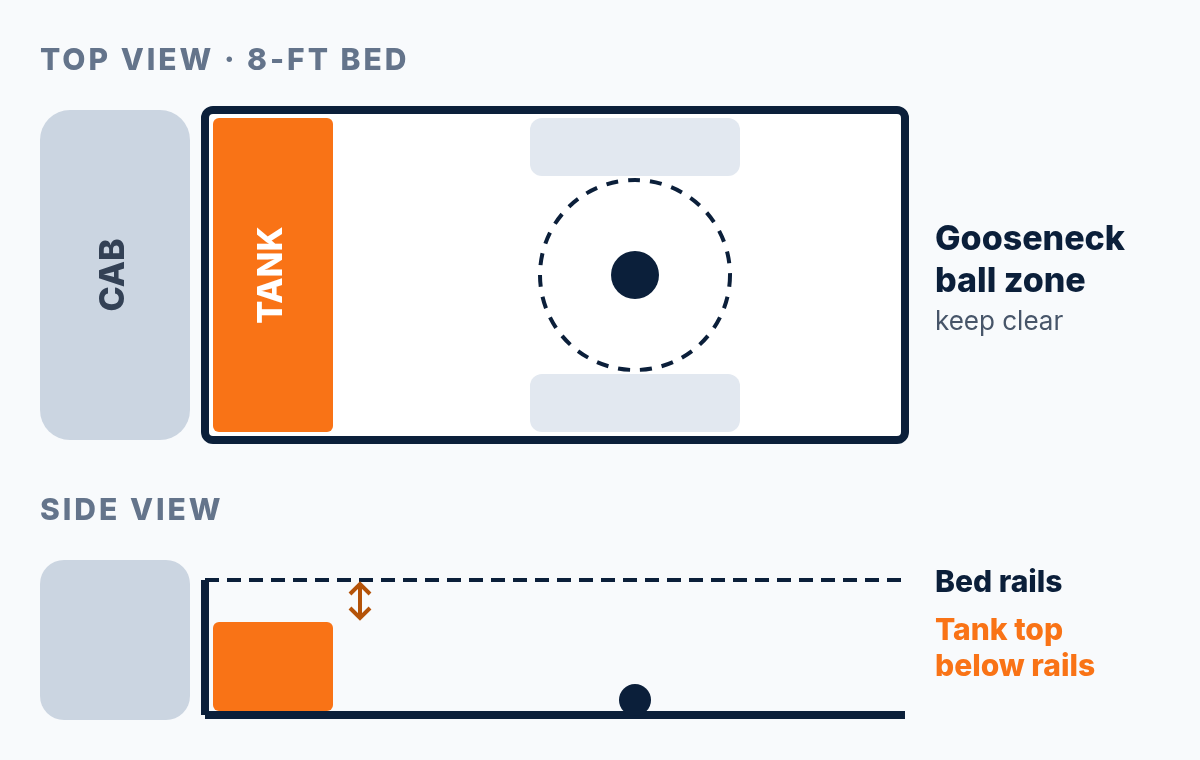
Top and side view: tank against the front bulkhead, top below the bed rails, gooseneck ball left clear.
Illustration: Fleet Intel with Steve (original diagram, illustrative, not to scale). © 2026 Steven Nohrden. No specific product shown.
What it is
A transfer (refueling) tank is a steel or aluminum tank that bolts into the bed, with a 12-volt pump, hose, and nozzle for fueling other equipment. Makers describe them as a way to fuel generators, ATVs, boats, and equipment wherever the truck goes, and some kits ship with a 12V pump and cab-mounted switch. (RDS, Transfer Flow)
Why fleets use one
Jobsite fueling. Instead of hauling generators, light towers, compressors, or a skid steer to a fuel station, the truck brings the fuel to them. That means less downtime and fewer trips off site.
Fitment: making it work with a gooseneck
- Know where the ball is. Ford says a gooseneck’s tongue weight rests on the bed over the rear axle, and its factory 5th-wheel/gooseneck prep comes in 8-ft bed versions. (Ford 2026 Towing Guide (PDF))
- Keep the tank at the front. Narrow cross-bed tanks and L-shaped tanks sit against the front bulkhead, leaving the center of the bed open. ATTA says its L-shape tanks are made for long-bed diesel trucks only. (ATTA Tank)
- Stay below the rails. Low-profile “under bed cover” tanks keep their highest point below the bed rails, so a tonneau or over-the-rail toolbox still fits. (ATTA Tank)
- Check the heights and corners. RDS lists L-shaped combos from 19″ to 26″ tall and tells buyers to measure for clearance at corners and wheel wells. (RDS)
- Mount it right. Use the maker’s mounting brackets or tabs, bolt through the bed floor, and keep straps or hardware clear of the hitch swing zone. Ford also notes its factory 5th-wheel and gooseneck hitches can’t be used with drop-in bedliners or bed mats. (Ford 2026 Towing Guide (PDF))
The rules (diesel vs. gasoline)
- Diesel: Under 49 CFR 173.150, a flammable liquid with a flash point at or above 100°F can be reclassed as a combustible liquid, and combustible liquids in non-bulk packaging are not subject to the federal hazmat rules unless they are a hazardous substance, waste, or marine pollutant.
- 119 gallons is the line. PHMSA told a Georgia road builder that diesel in auxiliary dispensing tanks of 119 gallons or less each qualifies for that exception. (PHMSA letter 08-0094) If several tanks are connected, PHMSA says shutoff valves must isolate them in transit, or they count as one bulk package. (PHMSA letter 23-0018)
- If it feeds the truck’s engine, PHMSA points to the FMCSA fuel-system rules (49 CFR 393.65 and 393.67). (PHMSA letter 08-0094)
- Gasoline is different. Gasoline can’t use the combustible-liquid exception, and the materials-of-trade exception caps most packages at 8 gallons. (49 CFR 173.6) Larger gasoline refueling tanks are built under a DOT special permit, such as DOT-SP 14227. (PHMSA letter 21-0001)
Rules vary by state and change often. Confirm with the state agency before acting: PHMSA · FMCSA · AZ DPS
Local fire codes and job-site rules may add requirements. Brands are named only as examples and are not endorsements. No prices, discounts, or financing are listed.
Sources: PHMSA letter 08-0094 · PHMSA letter 23-0018 · PHMSA letter 21-0001 · 49 CFR 173.150 · 49 CFR 173.6 · Ford 2026 Towing Guide (PDF) · RDS · ATTA Tank · Transfer Flow
← Back to Issue #1: all stories
Meet Steve
Your vehicles shouldn’t be one of your stressors
I’m Steven Nohrden, a Commercial/Government Account Manager for Ford Vehicle Sales with Chapman Ford Pro Elite in Scottsdale. I work with construction, trades, mining, and government fleets across Arizona and the Southwest. Here’s what working with me looks like:
- Weekly, customized updates on every unit you have coming.
- Full transparency on ETAs and upfits, including the delays.
- Fast, frequent communication. You won’t have to chase me.
- Someone pushing for you. Ford’s national account teams know me as polite, respectful, and always first to push for my customers. That goodwill gets my customers extra attention.
“With Steve, the answer’s yes, what’s the question so I can get it done.”
Hit reply and tell me what you need. I read every response.
| Email Steve |
Independent publication. Fleet Intel with Steve is an independent newsletter written by Steven Nohrden. It is not sponsored, endorsed, or published by Ford Motor Company or Ford Pro, and the views here are my own. Ford, F-150, Super Duty, Transit, E-Series, Police Interceptor, Ford Pro, and Ford Energy are trademarks of Ford Motor Company, used here only to identify products and news.
Researched and drafted with help from Steven Nohrden’s SI personal assistant (Grok Bot)  Steve reviews every issue, but mistakes are possible. Please check the linked sources before relying on any item.
Not legal or compliance advice. Regulations differ by state and change often. Confirm requirements with the agency linked in each item before you act. Items marked “Unconfirmed — insider intel” are early information we could not fully verify by press time.
Photos. Images are public domain or Creative Commons photos from Wikimedia Commons, plus original diagrams, each credited directly under the image. Some are illustrative rather than the exact vehicle or site in the story. Manufacturer badges were blurred where noted.
© 2026 Steven Nohrden. All rights reserved.
| Email Steve |