
Fleet Intel with Steve · Issue #1 · Jobs
Pay, training time, and outlook for 13 skilled trades, from elevator mechanics to diesel techs, plus ways training may be paid for.
The gist
- Elevator installers ($109,910) and power-line workers ($95,320) lead this list on national median pay. The median for all U.S. jobs is $50,980 (May 2025).1
- Most of these careers start with a high school diploma plus paid apprenticeship or on-the-job training, not a four-year degree.2,3
- Pell Grants, WIOA, apprenticeship wages, and the GI Bill may help pay for training. Eligibility varies, so check with each program.
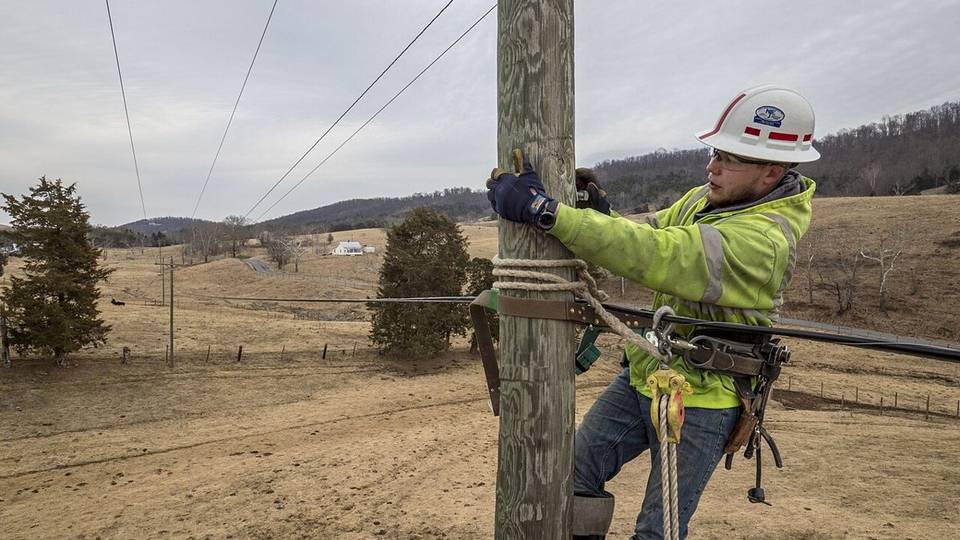
A lineworker frames a utility pole for new cable in rural Virginia. Lineworkers earned a national median of $95,320 in May 2025.1 (Illustrative photo, not taken in Arizona.)
Photo: Preston Keres, U.S. Department of Agriculture (2018), public domain, via Wikimedia Commons.

Why this matters
Skilled trades are where a lot of good pay is, and you can usually get in without a four-year degree. Every job in the table below has a higher median wage than all U.S. jobs combined ($50,980) and all Arizona jobs combined ($50,060).1,4 Several are also exactly the people Southwest fleets run on: mechanics, operators, and drivers.
The pay table
| Job | U.S. median | AZ median | Typical path | Outlook 2025–35 |
|---|---|---|---|---|
| Elevator & escalator installers | $109,910 | —* | 4-yr apprenticeship; most states license | +6% |
| Electrical power-line installers | $95,320 | $75,420 | Apprenticeship up to 3 yrs; journey level in 3–4 yrs | +10% |
| Locomotive engineers | $81,410 | $89,840 | 3+ months on the job; FRA certification | +1%† |
| Boilermakers | $76,410 | $77,940 | 4-yr apprenticeship | −2% |
| Construction & building inspectors | $74,690 | $73,440 | Trade experience (often 5+ yrs); license or cert. | 0% |
| Crane & tower operators | $68,080 | $67,350 | Years of related work; OSHA-required certification | +1%† |
| Mobile heavy equipment mechanics | $65,510 | $64,980 | 1–2 yr program or on the job; fully qualified in 3–4 yrs | +7%† |
| Plumbers, pipefitters & steamfitters | $63,800 | $62,070 | 4–5 yr apprenticeship | +7% |
| Electricians | $63,190 | $61,060 | 4–5 yr apprenticeship | +9% |
| Diesel technicians | $61,770 | $61,680 | On the job or diesel program; ASE certs | +4% |
| HVAC mechanics & installers | $61,010 | $59,400 | 6-mo to 2-yr program; EPA 608 | +11% |
| Operating engineers (equipment operators) | $59,850 | $60,620 | On the job or 3–4 yr apprenticeship | +4%† |
| Heavy & tractor-trailer truck drivers | $58,640 | $58,080 | CDL school, 3–6 months | +4% |
Source: U.S. Bureau of Labor Statistics, Occupational Employment and Wage Statistics, May 2025 (annual median wages, national and Arizona)1,4; Occupational Outlook Handbook (training paths and projected employment change, 2025–35; the average for all jobs is 3%).2 Medians are the midpoint: half of workers earn more, half earn less. OEWS covers wage and salary workers, not the self-employed. *Arizona estimate not published. †Outlook shown is for the broader BLS group (railroad workers; material moving machine operators; heavy vehicle and mobile equipment technicians; construction equipment operators).
Across the Southwest
The same job can pay very differently a few hundred miles away. California and Nevada lead on several of these trades:
| Job | AZ | NM | TX | CA | NV |
|---|---|---|---|---|---|
| Power-line installers | $75.4K | $76.5K | $78.9K | $129.0K | $96.6K |
| Operating engineers | $60.6K | $52.0K | $50.5K | $87.2K | $71.4K |
| Mobile heavy equip. mechanics | $65.0K | $63.6K | $61.9K | $78.5K | $79.9K |
| Electricians | $61.1K | $58.4K | $58.6K | $76.2K | $73.6K |
| Diesel technicians | $61.7K | $55.9K | $58.8K | $74.0K | $68.4K |
| Heavy truck drivers | $58.1K | $50.5K | $56.3K | $60.2K | $62.3K |
Source: U.S. Bureau of Labor Statistics, May 2025 State Occupational Employment and Wage Estimates, annual median wages, rounded to the nearest $100.4 Pay differs with local cost of living, union coverage, and the mix of employers in each state.
How to get in: training, certifications, and time
- Electricians and plumbers. Most learn through a 4- or 5-year apprenticeship with about 2,000 hours of paid on-the-job training each year plus classroom instruction.2,5 Arizona-registered apprenticeships combine at least 2,000 hours on the job with at least 144 classroom hours, and most run 3 to 4 years.3 Arizona licensing: the Registrar of Contractors licenses the contracting business, and a wage-earning employee doesn’t need a separate state contractor license. To qualify a contractor license, the “qualifying party” needs at least four years of trade experience.6,7 Some cities have their own rules, so check locally.
- Elevator mechanics. Typically a 4-year apprenticeship sponsored by a union, industry association, or employer. Apprentices usually start at about half of a fully trained mechanic’s pay, and most states require a license.8
- Lineworkers. Apprenticeships or employer programs last up to 3 years, and apprentices reach journey level after 3 or 4 years. Some community colleges offer 1-year certificates or 2-year degrees. Drivers of heavy line trucks usually need a CDL.9
- Boilermakers. Apprenticeships typically last 4 years. Some states require a license.10
- Building inspectors. Usually a high school diploma plus years of hands-on construction work, often 5 or more. Many states and cities require a license or certification.11
- Crane operators. Typically several years as an equipment operator, rigger, or signaler first. Federal OSHA requires construction crane operators to be certified by an accredited testing organization or licensed by a state or city. Certifications are valid for 5 years, and when certification is required, the employer must provide it at no cost to the employee.12,13
- Heavy equipment mechanics. Vocational or community college programs run 1 to 2 years for a certificate, or about 2 years for an associate degree. Trainees usually become fully qualified after 3 to 4 years of work.14 In metro Phoenix, Maricopa Community Colleges lists a Caterpillar Technician Training associate degree among its applied technology programs.15
- Diesel technicians. Many learn on the job, but employers may prefer a postsecondary diesel program.16 ASE certification requires passing an ASE test plus hands-on work experience (or a mix of formal training and experience), and the amount of experience varies by test.17
- HVAC technicians. Programs last 6 months to 2 years. EPA rules require technicians who service equipment that could release refrigerant to hold Section 608 certification (Type I, II, III, or Universal). The credential doesn’t expire, and supervised apprentices are exempt.18,19
- Equipment operators. Many learn on the job, and others complete a 3- or 4-year apprenticeship. Many need a CDL to haul their machines between jobsites.20
- Truck drivers. Truck-driving school at a private school or community college lasts 3 to 6 months, followed by several weeks with a mentor driver.21 First-time Class A or B CDL applicants must complete FMCSA Entry-Level Driver Training with a provider on the federal Training Provider Registry.22
- Locomotive engineers. Typically 3 or more months of on-the-job training, then certification under Federal Railroad Administration rules, administered by the railroad.23
- Mining (big in Arizona copper country). MSHA requires at least 40 hours of training for new underground miners before they start work, at least 24 hours for new surface miners, and 8 hours of refresher training every year.24 Underground mining loader operators earned a national median of $74,500 (Arizona: $72,430) in May 2025.1,4
Rules vary by state and change often. Confirm with the state agency before acting: Arizona Registrar of Contractors · Arizona Apprenticeship Office · CareerOneStop license finder (all states)
Ways to pay for training (may be available)
Please read: disclosure
This article is for general information only. It is not financial, legal, educational, or career advice. Eligibility, award amounts, and program availability vary by person and change over time, so confirm the details with the school, program, or agency before you apply: StudentAid.gov · Apprenticeship.gov · ARIZONA@WORK · VA education benefits. Wage figures are BLS medians for May 2025; actual pay varies by location, experience, and employer. Schools, programs, unions, and organizations are named only as examples, not endorsements. No lender is recommended, and no loan rates or terms are given. Steven Nohrden, Chapman Ford Pro Elite, and Ford Motor Company receive no compensation from any program listed here.
- Registered Apprenticeship (earn while you learn). Apprentices are paid employees who get on-the-job training plus classroom instruction, often sponsored by employers, unions, or industry groups. Search openings on Apprenticeship.gov or contact the Arizona Apprenticeship Office.25,26,3
- Federal Pell Grants and other federal student aid. Federal grants go to eligible students at colleges, career schools, and universities. Pell Grants go to undergraduates with exceptional financial need, and they don’t have to be repaid like loans. The first step is the free FAFSA at StudentAid.gov.27
- Workforce Pell (new in 2026). Pell Grants can now cover approved short-term programs of 8 to 15 weeks (150 to 599 clock hours) at accredited schools. Programs must be approved by the governor and the U.S. Secretary of Education and meet completion, job placement, and earnings standards, so ask the school whether its program qualifies.28
- WIOA training funds through ARIZONA@WORK. Eligible adults, dislocated workers, and youth may get training through approved programs on Arizona’s Eligible Training Provider List. Programs must lead to a recognized credential in an in-demand Arizona occupation.29,30
- GI Bill and VA benefits. Veterans in on-the-job training or apprenticeships may be able to use GI Bill benefits toward living expenses, and Post-9/11 GI Bill users may also get help with books and supplies.31
- Employer tuition assistance. Some employers pay for training. Under federal tax rules, employer educational assistance can be tax-free to the employee up to IRS limits.32
- Scholarships. Industry foundations offer trade-school scholarships. One example is the mikeroweWORKS Work Ethic Scholarship Program for students training in welding, plumbing, electrical, HVAC, construction, and other skilled trades.33
Don’t see a dollar figure? That’s on purpose. Award amounts depend on the person and the program, so get them straight from the agency or school.
The fleet angle
- Openings are constant. BLS projects about 24,400 openings a year for diesel technicians and about 214,500 a year for heavy truck drivers nationwide, mostly to replace workers who retire or change careers.16,21
- Grow your own. Employers can register their own apprenticeship program with the Arizona Apprenticeship Office.26 Tuition help can also be a tax-advantaged benefit (see IRS Publication 15-B).32
- Budget for credentials. If your crew runs construction cranes, OSHA puts the cost of operator certification on the employer.13
Please read: disclosure
This article is for general information only. It is not financial, legal, educational, or career advice. Eligibility, award amounts, and program availability vary by person and change over time, so confirm the details with the school, program, or agency before you apply: StudentAid.gov · Apprenticeship.gov · ARIZONA@WORK · VA education benefits. Wage figures are BLS medians for May 2025; actual pay varies by location, experience, and employer. Schools, programs, unions, and organizations are named only as examples, not endorsements. No lender is recommended, and no loan rates or terms are given. Steven Nohrden, Chapman Ford Pro Elite, and Ford Motor Company receive no compensation from any program listed here.
Sources
- U.S. Bureau of Labor Statistics. Occupational Employment and Wage Statistics: May 2025 National Occupational Employment and Wage Estimates. Washington, DC: BLS, 2026. Figures retrieved through the BLS Public Data API on November 13, 2026. https://www.bls.gov/oes/current/oes_nat.htm
- U.S. Bureau of Labor Statistics. “Electricians.” Occupational Outlook Handbook. Accessed November 13, 2026. https://www.bls.gov/ooh/construction-and-extraction/electricians.htm
- Arizona Department of Education. “Registered Apprenticeships.” Accessed November 13, 2026. https://www.azed.gov/cte/registered-apprenticeships
- U.S. Bureau of Labor Statistics. Occupational Employment and Wage Statistics: May 2025 State Occupational Employment and Wage Estimates (Arizona, New Mexico, Texas, California, Nevada). Washington, DC: BLS, 2026. Figures retrieved through the BLS Public Data API on November 13, 2026. AZ · NM · TX · CA · NV
- U.S. Bureau of Labor Statistics. “Plumbers, Pipefitters, and Steamfitters.” Occupational Outlook Handbook. Accessed November 13, 2026. https://www.bls.gov/ooh/construction-and-extraction/plumbers-pipefitters-and-steamfitters.htm
- Arizona State Legislature. “Arizona Revised Statutes § 32-1121, Persons not required to be licensed.” Accessed November 13, 2026. https://www.azleg.gov/ars/32/01121.htm
- Arizona State Legislature. “Arizona Revised Statutes § 32-1122, Qualifications for license.” Accessed November 13, 2026. https://www.azleg.gov/ars/32/01122.htm
- U.S. Bureau of Labor Statistics. “Elevator and Escalator Installers and Repairers.” Occupational Outlook Handbook. Accessed November 13, 2026. https://www.bls.gov/ooh/construction-and-extraction/elevator-installers-and-repairers.htm
- U.S. Bureau of Labor Statistics. “Electrical Power-Line Installers and Repairers.” Occupational Outlook Handbook. Accessed November 13, 2026. https://www.bls.gov/ooh/installation-maintenance-and-repair/line-installers-and-repairers.htm
- U.S. Bureau of Labor Statistics. “Boilermakers.” Occupational Outlook Handbook. Accessed November 13, 2026. https://www.bls.gov/ooh/construction-and-extraction/boilermakers.htm
- U.S. Bureau of Labor Statistics. “Construction and Building Inspectors.” Occupational Outlook Handbook. Accessed November 13, 2026. https://www.bls.gov/ooh/construction-and-extraction/construction-and-building-inspectors.htm
- U.S. Bureau of Labor Statistics. “Material Moving Machine Operators.” Occupational Outlook Handbook. Accessed November 13, 2026. https://www.bls.gov/ooh/transportation-and-material-moving/material-moving-machine-operators.htm
- Occupational Safety and Health Administration. “29 CFR § 1926.1427, Operator training, certification, and evaluation.” Electronic Code of Federal Regulations. Accessed November 13, 2026. https://www.ecfr.gov/current/title-29/section-1926.1427
- U.S. Bureau of Labor Statistics. “Heavy Vehicle and Mobile Equipment Service Technicians.” Occupational Outlook Handbook. Accessed November 13, 2026. https://www.bls.gov/ooh/installation-maintenance-and-repair/heavy-vehicle-and-mobile-equipment-service-technicians.htm
- Maricopa Community Colleges. “Applied Technology: Degrees and Certificates.” Accessed November 13, 2026. https://www.maricopa.edu/degrees-certificates/applied-technology
- U.S. Bureau of Labor Statistics. “Diesel Service Technicians and Mechanics.” Occupational Outlook Handbook. Accessed November 13, 2026. https://www.bls.gov/ooh/installation-maintenance-and-repair/diesel-service-technicians-and-mechanics.htm
- National Institute for Automotive Service Excellence (ASE). “Become Certified.” Accessed November 13, 2026. https://www.ase.com/become-certified
- U.S. Bureau of Labor Statistics. “Heating, Air Conditioning, and Refrigeration Mechanics and Installers.” Occupational Outlook Handbook. Accessed November 13, 2026. https://www.bls.gov/ooh/installation-maintenance-and-repair/heating-air-conditioning-and-refrigeration-mechanics-and-installers.htm
- U.S. Environmental Protection Agency. “Section 608 Technician Certification Requirements.” Accessed November 13, 2026. https://www.epa.gov/section608/section-608-technician-certification-requirements
- U.S. Bureau of Labor Statistics. “Construction Equipment Operators.” Occupational Outlook Handbook. Accessed November 13, 2026. https://www.bls.gov/ooh/construction-and-extraction/construction-equipment-operators.htm
- U.S. Bureau of Labor Statistics. “Heavy and Tractor-Trailer Truck Drivers.” Occupational Outlook Handbook. Accessed November 13, 2026. https://www.bls.gov/ooh/transportation-and-material-moving/heavy-and-tractor-trailer-truck-drivers.htm
- Federal Motor Carrier Safety Administration. “Entry-Level Driver Training (ELDT).” Accessed November 13, 2026. https://www.fmcsa.dot.gov/registration/commercial-drivers-license/entry-level-driver-training-eldt
- U.S. Bureau of Labor Statistics. “Railroad Workers.” Occupational Outlook Handbook. Accessed November 13, 2026. https://www.bls.gov/ooh/transportation-and-material-moving/railroad-occupations.htm
- Mine Safety and Health Administration. “30 CFR Part 48, Training and Retraining of Miners (§§ 48.5, 48.25).” Electronic Code of Federal Regulations. Accessed November 13, 2026. https://www.ecfr.gov/current/title-30/chapter-I/subchapter-H/part-48
- U.S. Department of Labor. “Apprenticeship Job Finder.” Apprenticeship.gov. Accessed November 13, 2026. https://www.apprenticeship.gov/apprenticeship-job-finder
- Arizona Department of Economic Security. “Apprenticeship Program.” Accessed November 13, 2026. https://des.az.gov/services/employment/apprenticeship-program
- Federal Student Aid, U.S. Department of Education. Federal Grant Programs. Fact sheet. Accessed November 13, 2026. https://studentaid.gov/sites/default/files/federal-grant-programs.pdf
- U.S. Department of Education. “Fact Sheet: Trump Administration Implements Workforce Pell Grant Provisions of the Working Families Tax Cuts Act.” May 2026. Accessed November 13, 2026. https://www.ed.gov/media/document/workforce-pell-grant-final-rule-fact-sheet-114075.pdf
- Arizona Department of Economic Security. “Eligible Training Provider List (ETPL).” Accessed November 13, 2026. https://des.az.gov/services/employment/workforce-innovation-and-opportunity-act-wioa/eligible-training-provider-list
- ARIZONA@WORK. “Find Training and Apprenticeships.” Accessed November 13, 2026. https://arizonaatwork.com/job-seeker-services/find-training-and-apprenticeships
- U.S. Department of Veterans Affairs. “On-the-Job Training and Apprenticeships.” Accessed November 13, 2026. https://www.va.gov/education/about-gi-bill-benefits/how-to-use-benefits/on-the-job-training-apprenticeships/
- Internal Revenue Service. Publication 15-B, Employer’s Tax Guide to Fringe Benefits. Accessed November 13, 2026. https://www.irs.gov/publications/p15b
- mikeroweWORKS Foundation. “Work Ethic Scholarship Program.” Accessed November 13, 2026. https://mikeroweworks.org/scholarship/
Citation style: numbered notes keyed to this list, adapted from The Chicago Manual of Style (titles of reports and handbooks in italics, page and section titles in quotation marks). Wage data: BLS OEWS, May 2025, the most recent release as of publication.
← Back to Issue #1: all stories
Meet Steve
Your vehicles shouldn’t be one of your stressors
I’m Steven Nohrden, a Commercial/Government Account Manager for Ford Vehicle Sales with Chapman Ford Pro Elite in Scottsdale. I work with construction, trades, mining, and government fleets across Arizona and the Southwest. Here’s what working with me looks like:
- Weekly, customized updates on every unit you have coming.
- Full transparency on ETAs and upfits, including the delays.
- Fast, frequent communication. You won’t have to chase me.
- Someone pushing for you. Ford’s national account teams know me as polite, respectful, and always first to push for my customers. That goodwill gets my customers extra attention.
“With Steve, the answer’s yes, what’s the question so I can get it done.”
Hit reply and tell me what you need. I read every response.
| Email Steve |
Independent publication. Fleet Intel with Steve is an independent newsletter written by Steven Nohrden. It is not sponsored, endorsed, or published by Ford Motor Company or Ford Pro, and the views here are my own. Ford, F-150, Super Duty, Transit, E-Series, Police Interceptor, Ford Pro, and Ford Energy are trademarks of Ford Motor Company, used here only to identify products and news.
Researched and drafted with help from Steven Nohrden’s SI personal assistant (Grok Bot)  Steve reviews every issue, but mistakes are possible. Please check the linked sources before relying on any item.
Not legal or compliance advice. Regulations differ by state and change often. Confirm requirements with the agency linked in each item before you act. Items marked “Unconfirmed — insider intel” are early information we could not fully verify by press time.
Photos. Images are public domain or Creative Commons photos from Wikimedia Commons, plus original diagrams, each credited directly under the image. Some are illustrative rather than the exact vehicle or site in the story. Manufacturer badges were blurred where noted.
© 2026 Steven Nohrden. All rights reserved.
| Email Steve |