
Fleet Intel with Steve · Issue #1 · Autonomy
A plain-English guide for people who drive hours every day: what is real today, what is coming, and what is still unproven.
The gist
- The industry uses SAE levels 0 through 5. On vehicles you can buy today, what you usually get is Level 2: the truck can steer and manage speed, but you are still the driver and your eyes stay on the road.1,2
- Level 4 is already a service in the Southwest — Waymo robotaxis in metro Phoenix, driverless freight on Phoenix–Texas lanes, and autonomous haul trucks at mines — but you cannot buy that capability in a personal truck and work the whole commute.3,4,5
- Ford says its hands-free BlueCruise is Level 2, and that Level 3 “eyes-off” driving will be road-ready in 2028. That is a plan, not a product in the showroom yet.2,6
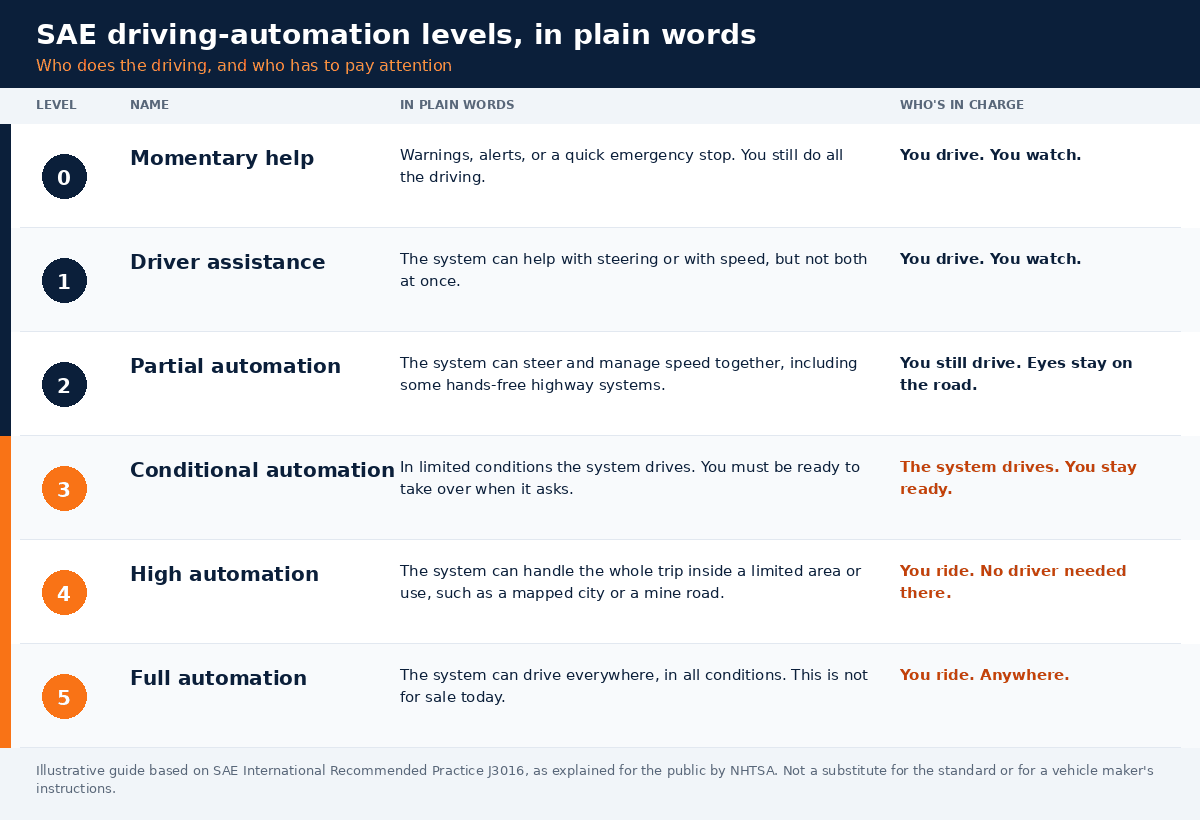
The six SAE levels, in plain words. Levels 0–2 are driver support. Levels 3–5 are automated driving systems.1,7
Illustration: Fleet Intel with Steve (original diagram, illustrative). Based on SAE International Recommended Practice J3016, as explained by NHTSA. © 2026 Steven Nohrden.
Why this matters on a long drive home
A lot of mid-level construction managers I know spend hours every day behind the wheel, bouncing between jobsites, suppliers, and the office. The promise of safe Level 4 autonomy is personal: you could work the miles, finish the day’s leftover tasks, and still get home in time for family. That would be life-changing. It is also not something you can buy in a pickup today, and I want to be straight with you about the difference.
The honest split is this. Level 2 is in trucks and SUVs you can order now: hands-free on many highways, eyes still on the road.2 Limited Level 3 was sold to the public in a few luxury cars, under tight conditions, and that first wave has been pulled back.8,9 Level 4 is already running as a service in the Southwest — a ride you take, or a freight lane a carrier uses, or a haul truck inside a mine fence — not as a feature in a vehicle you personally own and work in while it drives.3,5 Level 5, anywhere and anytime, is not for sale.1
The levels, in plain words
The Society of Automotive Engineers, SAE, publishes Recommended Practice J3016, the taxonomy almost everyone uses.10 NHTSA explains those six levels for the public, and that is the wording this article follows.1,7 A short version:
- Level 0. Warnings or a momentary emergency intervention, such as automatic emergency braking. You do all the driving.1
- Level 1. The system helps continuously with steering or with speeding and braking (for example, adaptive cruise), but not both at once. You still drive and you watch.1
- Level 2. The system can steer and manage speed together. Some systems let you take your hands off the wheel on mapped highways. You are still the driver. Your eyes stay on the road, and you must be ready to resume control at any time.1,2
- Level 3. In a defined set of conditions, the system handles the driving. You must remain available and take over when it requests. This is the first level at which you are not driving while the system is engaged — and the handoff back to you is the hard part.1,8
- Level 4. Inside a limited service area or use case (a geofenced city, a mapped freight corridor, a mine or quarry road), the system can do the entire driving task. Occupants ride. A human driver is not needed while the system is operating in that domain.1
- Level 5. The system can drive under all conditions, on all roadways. NHTSA says this is not available on today’s vehicles for consumer purchase.1
Marketing names are not SAE levels. A feature can sound like self-driving and still be Level 2. When in doubt, ask who is responsible if something goes wrong while the system is on, and whether you are allowed to look away.
What is already running in Arizona and the Southwest
Robotaxis in metro Phoenix. Waymo has offered fully driverless ride-hailing here for years, and it is the company’s public service in Phoenix, with other cities as well.3 In August 2026, Waymo expanded farther into the East Valley — including Gilbert and more of Chandler — adding about 55 square miles and bringing the Valley footprint to more than 350 square miles. Phoenix Sky Harbor and Scottsdale Airpark were already served; the company said Phoenix-Mesa Gateway Airport would be added.4 That is Level 4 as a ride, in a mapped area, not a vehicle you take home. It is also a reminder that “already running” is not the same as finished: on Nov. 6, NHTSA opened a recall query into whether a 2025 Waymo software fix stopped its vehicles from illegally passing stopped school buses; TechCrunch reported that most of the incidents in the filing came after the fix. Waymo said it has made significant improvements and had received no citations since March 2026, and that it would respond to the query.11
Driverless trucks on Southwest freight lanes. In February 2026, Aurora said it had validated driverless operations on an approximately 1,000-mile lane between Fort Worth and Phoenix, plus freight movements among Dallas, Houston, El Paso, Phoenix, and Laredo.5 The company has also said those longer runs can beat a single human driver’s hours-of-service clock because the truck does not have to stop for a mandatory rest break.5 That is an operational claim about transit time, not a reason to ignore highway safety or the rules that still apply to human drivers. In early November, Aurora said supply-chain and component-quality issues had pushed its goal of more than 200 driverless trucks from the end of 2026 into February.12
The I-45 launch lane, and industrial runs already without a driver. Kodiak has named the Dallas–Houston lane, 219 miles along Interstate 45, as its first long-haul driverless highway service, and in September it said it was on track to finish its safety case and begin unsupervised service by the end of 2026.13 That is a target, not a completed public launch as of our deadline. Kodiak has already run commercial driverless trucks with no one in the cab for Atlas Energy Solutions in the Permian Basin of West Texas and eastern New Mexico, beginning in December 2024.13
Mines and quarries, where Level 4 showed up first. Freeport’s approved $4.5 billion expansion at Bagdad, in Yavapai County, includes a fully autonomous truck fleet; the mine already runs autonomous Caterpillar 793 haul trucks.14 That story, including Resolution Copper’s next step near Superior, is in this issue’s Arizona copper article. Komatsu and TIER IV also announced today (Nov. 13) a plan to bring autonomous dump trucks to quarry and construction sites in North America in 2027; Caterpillar has been expanding autonomy on smaller quarry trucks. Details are in the heavy-equipment article.15 Those are closed or controlled sites, not the open highway of a superintendent’s daily commute.
What you can actually buy, and who has announced plans
Ford BlueCruise is hands-free Level 2, not eyes-off. Ford describes BlueCruise as a Level 2 driver-assistance system: on designated highways, called Blue Zones, you can take your hands off the wheel, but the vehicle “requires your full attention and you must be ready to resume control at any time.”2 Ford says it is available on 97% of U.S. and Canadian controlled-access highways, with 1.2 million equipped vehicles on the road and more than half a billion highway miles of use.2 A driver-facing camera watches your eyes and head position. It is not a self-driving system, and Ford says it should not be used when rain, fog, or snow keep the cameras and radar from seeing the lane lines.2
Ford’s announced next step is Level 3 in 2028. In a January 8, 2026, From the Road post accompanying Ford’s CES remarks, Doug Field, Ford’s chief EV, digital, and design officer, wrote that new hardware and software would arrive starting in 2027 on Ford’s Universal Electric Vehicle platform, and that “L3 eyes-off driving will be road ready in 2028.”6 Ford has not, in the materials we reviewed, announced a plan to sell a Level 4 vehicle to the public. Treat 2028 as a stated target, not a guarantee, and expect limits on where and when any Level 3 system may be used.
Mercedes-Benz was first to sell certified Level 3 in the United States — and then paused it. In January 2023, Mercedes said Drive Pilot was the first SAE Level 3 system in a production vehicle authorized for U.S. public freeways, starting in Nevada, as an option on model-year 2024 S-Class and EQS Sedan models.8 California’s DMV issued a deployment permit in June 2023, making Mercedes the first company authorized to sell or lease a vehicle with an automated driving system to the public in that state. The permit limited the system to designated highways, daylight, and speeds of no more than 40 mph, and excluded city streets, construction zones, and heavy rain or fog, among other conditions. Owners had to watch a mandatory video before the system was activated.16 Mercedes’ owner information describes a fallback-ready user who may look away only while the system is active and who must take over when asked.17
In January 2026, Mercedes said the revised S-Class would not offer Drive Pilot. A company spokesperson, Tobias Mueller, told The Verge the feature was being paused because its limited operating conditions did not offer customers much benefit, and because a more useful system could come in the next two or three years.9 That is the most important lesson in the Level 3 story so far: being first to sell it did not mean the allowed conditions were wide enough to change a workday commute.
BMW offered Level 3 in Germany, then dropped it, and did not sell it in the U.S. In March 2026, BMW’s research-and-development chief, Joachim Post, said demand for Personal Pilot L3 was not at a profitable level and that BMW no longer had a Level 3 offer, while leaving the door open if a feasible business model appears.18 We did not find a U.S. retail offering of that system. Other automakers have talked about robotaxis or in-house software; unless a company has publicly said it will sell Level 3 or Level 4 capability to the public, with a stated timeline, it does not belong on this list. We dropped any claim we could not source.
So when could you work while riding?
Here is the warm, honest version. What is real today: you can take a Waymo across much of metro Phoenix and use that time as a passenger.3,4 You can use BlueCruise on a long I-10 or I-17 run to rest your hands, not your eyes, and only where the system is designed to work.2 Mines and some freight lanes are already moving goods with no one in the cab, inside defined domains.14,5,13
What is coming: Ford has said Level 3 eyes-off driving will be road-ready in 2028.6 Kodiak is aiming to open unsupervised I-45 service by year-end, and Aurora is still scaling its Sun Belt lanes.13,5,12 Those could change how freight moves through Arizona and Texas. They are not the same thing as a superintendent commuting from a jobsite in a personally owned truck, laptop open, legally and safely checked out of the driving task.
What is still unproven: a consumer Level 4 — or even a widely useful Level 3 — that works for hours of mixed city and highway driving, in work trucks, in the weather and construction zones this region actually has. Mercedes’ and BMW’s retreats from first-generation Level 3 show that a certified system can still be too narrow to matter.9,18 The handoff from machine back to a distracted human is a known safety concern, which is one reason many robotaxi and trucking companies skip Level 3 and go for Level 4, where the system does not rely on you to grab the wheel in a few seconds. Until a maker sells a system that is approved for eyes-off use on the roads you actually drive, the right move is to use today’s assistance as assistance, and to keep your mind on the road and your family waiting at the other end.
Safety and legality
Today, the consumer vehicles you can buy are Level 2 or, at most, a limited Level 3 system sold under tight conditions. NHTSA’s current public guidance is that even the highest automation available to consumers still requires the driver’s full engagement, and that no vehicle offered for sale in the United States is fully self-driving.1 If a system is engaged, you remain responsible for following the law and the vehicle maker’s instructions, including taking over when the system asks. In Arizona, a licensed driver may operate an automated vehicle when he or she can take back the driving task; fully driverless operation on public roads is allowed only after the operator files a law-enforcement plan and a written compliance statement with the state.19,20 This article is general information, not legal or driving advice. Confirm current rules with NHTSA, ADOT, and the maker of your vehicle.
Sources
- National Highway Traffic Safety Administration. “Automated Vehicle Safety.” Accessed November 13, 2026. https://www.nhtsa.gov/vehicle-safety/automated-vehicles-safety
- Ford Motor Company. “Designed for Trust: How BlueCruise Technology Collaborates with the Driver.” Ford From the Road. Accessed November 13, 2026. https://www.fromtheroad.ford.com/us/en/articles/2026/bluecruise--technology-designed-for-trust-driver-collaboration
- Waymo. “Self-Driving Car Service — Ride-Hailing in Phoenix, AZ.” Accessed November 13, 2026. https://waymo.com/rides/phoenix/
- Jeremy Duda. “Waymo expands Phoenix service area.” Axios Phoenix, August 13, 2026. Includes a statement from Waymo. Accessed November 13, 2026. https://www.axios.com/local/phoenix/2026/08/13/waymo-phoenix-east-valley-expansion-chandler-gilbert-gateway-airport
- Aurora Innovation, Inc.. “Aurora Triples Driverless Network to 10 Routes and Prepares to Expand Across U.S. Sun Belt.” Press release, February 11, 2026. Accessed November 13, 2026. https://ir.aurora.tech/news-events/press-releases/detail/132/aurora-triples-driverless-network-to-10-routes-and-prepares-to-expand-across-u-s-sun-belt
- Doug Field, Ford Motor Company. “Ford’s Simple Vision for Smart Tech: Make It for Everyone.” Ford From the Road, January 8, 2026. Field is Ford’s chief EV, digital, and design officer; the post accompanied Ford’s CES 2026 remarks. Accessed November 13, 2026. https://www.fromtheroad.ford.com/us/en/articles/2026/ford-affordable-smart-vehicle-technology-strategy
- National Highway Traffic Safety Administration. “Levels of Automation.” Consumer explainer (PDF), May 2022, based on SAE J3016. Accessed November 13, 2026. https://www.nhtsa.gov/sites/nhtsa.gov/files/2022-05/Level-of-Automation-052522-tag.pdf
- Mercedes-Benz Group. “Mercedes-Benz world’s first automotive company to certify SAE Level 3 system for U.S. market.” January 26, 2023. Accessed November 13, 2026. https://group.mercedes-benz.com/technology/autonomous-driving/driving/drive-pilot-nevada.html
- Andrew J. Hawkins. “Mercedes temporarily scraps its Level 3 ‘eyes-off’ driving feature.” The Verge, January 13, 2026. Quotes Mercedes-Benz spokesperson Tobias Mueller; first reported by Handelsblatt. Accessed November 13, 2026. https://www.theverge.com/transportation/860935/mercedes-drive-pilot-level-3-scrapped
- SAE International. Taxonomy and Definitions for Terms Related to Driving Automation Systems for On-Road Motor Vehicles, Recommended Practice J3016. The public explanations in this article follow NHTSA’s summary of that taxonomy. Standard record: https://www.sae.org/standards/content/j3016_202104/.
- Kirsten Korosec. “Waymo robotaxis kept illegally passing school buses after software fix, feds say.” TechCrunch, November 9, 2026. Reports a NHTSA recall query opened on a November 6, 2026, filing, and includes a statement from Waymo. Accessed November 13, 2026. https://techcrunch.com/2026/11/09/waymo-robotaxis-kept-illegally-passing-school-buses-after-software-fix-feds-say
- Jake Dabkowski. “Aurora Innovation delays 200-truck goal to February amid supply chain issues.” Yahoo Finance, reprinting a November 2, 2026, report on Aurora’s third-quarter earnings remarks by CEO Chris Urmson. Accessed November 13, 2026. https://finance.yahoo.com/technology/ai/articles/aurora-innovation-delays-200-truck-154214198.html
- Kodiak AI, Inc.. “Kodiak AI Names Dallas-Houston As Long-Haul Driverless Launch Lane, Consistently Completes Intervention-Free, End-to-End Deliveries.” Press release, September 25, 2026. Accessed November 13, 2026. https://kodiak.ai/news/kodiak-names-dallas-houston-driverless-launch-lane
- Freeport-McMoRan. “Freeport Announces Plans to Boost U.S. Copper, Molybdenum Production.” November 4, 2026. Also covered in this issue’s Arizona copper article. Accessed November 13, 2026. https://investors.fcx.com/investors/news-releases/news-release-details/2026/Freeport-Announces-Plans-to-Boost-U-S--Copper--Molybdenum-Production/default.aspx
- Komatsu Ltd. and TIER IV, Inc.. “TIER IV and Komatsu begin joint development of autonomous driving systems for three dump truck models toward deployment at quarry and construction sites in Japan and North America.” News release, November 13, 2026. Also covered in this issue’s heavy-equipment article. Accessed November 13, 2026. https://www.komatsu.jp/en/newsroom/2026/20261113
- California Department of Motor Vehicles. “California DMV Approves Mercedes-Benz Automated Driving System for Certain Highways and Conditions.” News release, June 8, 2023. Accessed November 13, 2026. https://www.dmv.ca.gov/portal/news-and-media/california-dmv-approves-mercedes-benz-automated-driving-system-for-certain-highways-and-conditions/
- Mercedes-Benz USA. “DRIVE PILOT.” Owner information page describing the certified system, its conditions, and the driver’s fallback role. Accessed November 13, 2026. https://www.mbusa.com/en/owners/manuals/drive-pilot
- Adrian Padeanu. “BMW Explains Why It’s Dropping Level 3 Self-Driving Tech.” BMWBlog, March 17, 2026. Quotes BMW research-and-development chief Joachim Post. Personal Pilot L3 was offered in Germany, not the United States. Accessed November 13, 2026. https://www.bmwblog.com/2026/03/17/bmw-explains-why-dropping-level-3-self-driving-tech/
- Arizona State Legislature. “Arizona Revised Statutes § 28-9702, Operation of autonomous vehicles.” Accessed November 13, 2026. https://www.azleg.gov/ars/28/09702.htm
- Arizona Department of Transportation. “Autonomous Vehicles Testing and Operating WITHOUT Driver.” Accessed November 13, 2026. https://azdot.gov/autonomous-vehicles-testing-and-operating-without-driver
Citation style: numbered notes keyed to this list, adapted from The Chicago Manual of Style (titles of reports, standards, and handbooks in italics; article and page titles in quotation marks). Accessed November 13, 2026. Dollar figures in linked mining stories are cited story facts; no vehicle prices, subscriptions, or financing terms are listed here.
← Back to Issue #1: all stories
Meet Steve
Your vehicles shouldn’t be one of your stressors
I’m Steven Nohrden, a Commercial/Government Account Manager for Ford Vehicle Sales with Chapman Ford Pro Elite in Scottsdale. I work with construction, trades, mining, and government fleets across Arizona and the Southwest. Here’s what working with me looks like:
- Weekly, customized updates on every unit you have coming.
- Full transparency on ETAs and upfits, including the delays.
- Fast, frequent communication. You won’t have to chase me.
- Someone pushing for you. Ford’s national account teams know me as polite, respectful, and always first to push for my customers. That goodwill gets my customers extra attention.
“With Steve, the answer’s yes, what’s the question so I can get it done.”
Hit reply and tell me what you need. I read every response.
| Email Steve |
Independent publication. Fleet Intel with Steve is an independent newsletter written by Steven Nohrden. It is not sponsored, endorsed, or published by Ford Motor Company or Ford Pro, and the views here are my own. Ford, F-150, Super Duty, Transit, E-Series, Police Interceptor, Ford Pro, and Ford Energy are trademarks of Ford Motor Company, used here only to identify products and news.
Researched and drafted with help from Steven Nohrden’s SI personal assistant (Grok Bot)  Steve reviews every issue, but mistakes are possible. Please check the linked sources before relying on any item.
Not legal or compliance advice. Regulations differ by state and change often. Confirm requirements with the agency linked in each item before you act. Items marked “Unconfirmed — insider intel” are early information we could not fully verify by press time.
Photos. Images are public domain or Creative Commons photos from Wikimedia Commons, plus original diagrams, each credited directly under the image. Some are illustrative rather than the exact vehicle or site in the story. Manufacturer badges were blurred where noted.
© 2026 Steven Nohrden. All rights reserved.
| Email Steve |